
Responsible Realism and Critical AI
Public lecture by Dagmar Monett, Berlin School of Economics and Law, Germany.

Abstract
The latest developments in the field of Artificial Intelligence (AI) have influenced the way people think of and interact with digital technologies – degenerative “AI” included, but not only – as well as what these artefacts can do in the present or will be able to do in the future. Anthropomorphic and dystopian views place them at the level of humans or above, attributing to them intelligent capabilities they do not possess. But, are these machines (apps, software, robots, chatbots, etc.) comparable to humans or intelligent?
On the one hand, the hype around their capabilities is higher than ever and fuels unrealistic narratives and expectations from which even AI practitioners and researchers cannot easily escape. Technological determinism and inevitability drive then the industry rhetoric, capturing users and forcing adoption even in settings where AI is not apt for application. On the other hand, institutions and individuals acknowledge the harms, risks, and shortcomings of AI systems; yet, simultaneously, encourage responsible adoption and use while delegating ethical responsibility to individual end users, thereby eschewing systemic and structural issues, as well as collective responsibility. This is a paradox embodied in Responsible Realism, which is an instance of ethics washing and obfuscates accountability.
How to deal with these issues critically? Shouldn’t a critical stance on AI precede adoption? Critical and informed decision making are essential for shaping how we interact with and what we get out of AI-based tools, but being aware of the harms alone does not reduce them.
This talk aims to reach a common understanding of Responsible Realism, Critical AI, and related terminology, concepts that will be explained in the scope of concrete examples. Special attention will be dedicated e.g. to the harms and unethical implications that arise when using AI-based tools in education, particularly those that are incompatible with academic integrity.
Bio
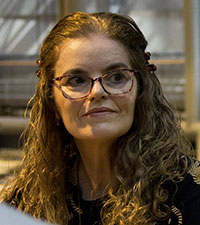 Dagmar Monett is a Computer Science Professor (Artificial Intelligence, Software Engineering) at the Berlin School of Economics and Law (HWR Berlin) and Director of the Computer Science Division at the Department of Cooperative Studies Business and Technology. She is also a Co-Founding Member of the Institute for Data-Driven Digital Transformation (d-cube, HWR Berlin) and a Board member of the Berlin Federation of Professors. With over 37 years of research and teaching experience in different countries, her research fields include but are not limited to AI, critical AI, software engineering, and computer science education.
Read more about Dagmar Monett at her personal website.
Sign up
Map of South Campus
View directions.
View on map of the Faculty of Humanities - South Campus.
View map of South Campus (pdf).