
Media Freedom and Re-democratization in Hungary
Event with keynotes by Kitti Ágoston, former Communication Director for Hungary's TISZA Party and Miklós Sükösd, Associate Professor at the University of Copenhagen.
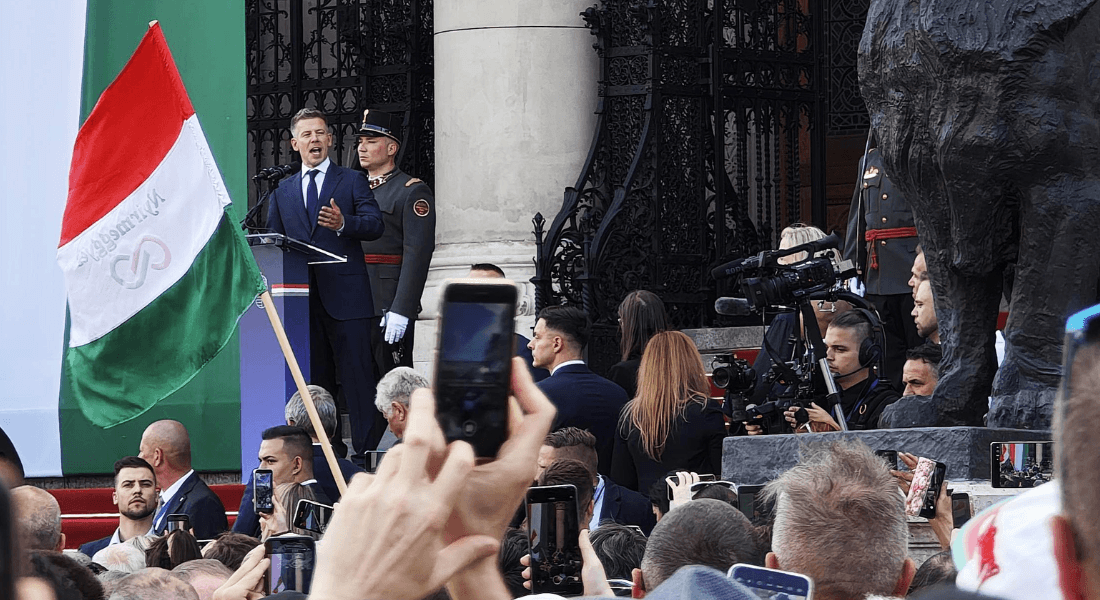
What role can media freedom play in democratic renewal? How can societies rebuild trust in journalism and public communication after periods of political polarization and media concentration?
Hungary’s election this year was a great victory for those fighting for democracy in Europe. The country entered a new and historic political chapter following a closely watched parliamentary election with important implications for freedom rights, political communication, and the future of independent media. At a time when questions of populism, democratic resilience and media freedom are being discussed across Europe, the United States and beyond, Hungary offers a particularly important case for understanding both the challenges and possibilities of democratic renewal.
With the participation of Kitti Ágoston, a chief communication strategist for the election winning TISZA Party during the election campaign, this event offers the opportunity to hear first-hand from someone with a key role in the recent Hungarian election.
Through keynote talks and an open discussion, participants will gain unique insights into Hungary's evolving political landscape and the broader questions of media freedom, democratic resilience and re-democratization that remain relevant far beyond Hungary's borders.
This event is hosted by the Department of Communication in collaboration with the Hungarian Embassy in Denmark. It is part of the commemoration of the 70th anniversary of the 1956 Hungarian Revolution, a defining moment in Hungary's struggle for freedom, national sovereignty and democratic self-determination. The ideals that inspired that revolution continue to resonate in contemporary discussions about democracy, and the role of free and independent media in society.
Programme
| 14:00-14:20 |
Words of welcome:
Opening remarks:
|
| 14:20-15:00 |
From movement to majority: Lessons from Hungary’s 2026 election campaign and the Communication challenges ahead
Political communication and digital organizing played a central role in turning a rapidly growing political movement into a nationwide campaign. Drawing on her experience leading communications and social organizing for TISZA, Kitti Ágoston will reflect on the strategic choices behind the 2026 campaign and the new communication challenges that emerge when political change moves from campaigning to governing. Kitti Ágoston is a political communication strategist and former Communication Director for Hungary’s TISZA Party during the 2026 parliamentary election campaign. |
| 15:00-15:25 |
From the populist propaganda state to the media welfare state: Challenges of re-democratization
How can Hungary build a democratic media system after authoritarian rule? Drawing on European comparative perspectives, Miklós Sükösd explores the challenges of ending political control, censorship and systemic corruption, rebuilding trust in public service media, and securing funding for pluralist journalism. Miklós Sükösd is Associate Professor of Communication at the University of Copenhagen, specializing in media and democracy, authoritarianism, and post-authoritarian transitions. In September 2026, he was elected to Hungary's Independent Public Media Board, which is tasked with rebuilding democratic public service media in the country. |
| 15:25-16:15 | QA discussion moderated by Manuel Menke (Associate Professor, Head of the Media Section, and a member of the Geopolitical Communication group at the Department of Communication) |
| 16:15-17:00 | Reception hosted by the Department of Communication and the Hungarian Embassy featuring Hungarian wines. |
Map of South Campus
View directions.
View on map of the Faculty of Humanities - South Campus.
View map of South Campus (pdf).
In collaboration with
 |